
Top Sleep Management Tips for Better Health
Welcome to WordPress. This is your first post. Edit or delete it, then start writing!


Tibolone is one such drug that acts as oestrogen in the brain but since it does not act in the breast, it will not increase your breast cancer risk. However, only women who have stopped their periods for at least six months can take Tibolone as it is a strictly no-bleed regimen drug. Tibolone does not have the same side effects or risks as conventional HRT but it does have a slight increase in stroke incidence.
“If you have a bad family history of heart disease, high blood pressure or liver blog problems, we would think twice about prescribing conventional HRT. We explain the pros and cons in every situation and if you’re still willing to go on it, we might start you on HRT. However, we will be monitoring your progress closely,” said Dr. Hoo. Age does not play a role so if you are younger and are having premature menopause, you will not increase your risk of breast cancer or stroke as studies have shown that these risks only increase when you attain a natural age of menopause (around 48 to 52)
“It is the duration (how long you take the drug) and risk profile (what risks already exist before you started the drug) that are more important than the age you begin the drug. I usually advise my patients that once they start HRT, they should take it for at least two years to get the maximum benefits,” said Dr. Hoo.
Do natural remedies work?
Dr. Hoo explains that it is important for women to check with their doctors before going on natural herbal remedies as these herbs could react with conventional medication, especially blood thinners.
“Studies have shown that Agnus castus, red clover and black cohosh provide benefits in relieving menopausal symptoms. There have been no proven benefits of ginseng, dong kwai and St. John’s Wort as yet. The jury is still out on wild yam. There is however a precautionary note on black from cohosh as studies showed it causes cancer in rats. If you are thinking of taking black cohosh, I would not recommend using it for more than six months continuously,” cautions Dr. Hoo.
If women decide they want to go off HRT and only focus on natural remedies, Dr. Hoo states that it is fine. After all, HRT is not a medication for life. The trick here is to know your options and weigh the pros and cons properly. Menopause does not have to be a bane. With the right knowledge, you can sail through it with the grace of a youth.
References: www.womenshealth.gov *
The information provided is for educational and communication purposes only and it should not be construed as personal medical advice. Information published in this article is not intended to replace, supplant or augment a consultation with a health professional regarding the reader’s own medical care. H&B does not give any warranty on accuracy, completeness, functionality, usefulness or other assurances as to the content appearing in this column. H&B disclaims all responsibilities for any loses, damage to property or personal injury suffered directly or indirectly from reliance on such information.
What is pharmacy compounding?
Pharmacy compounding is the customised preparation of a certain medication prescribed by doctors. It is the creation of a particular pharmaceutical product and is prepared by a licensed pharmacist at a compounding pharmacy. A specialty practice within the pharmacy community, pharmacy compounding is strictly regulated. Although there are thousands of approved drugs in the market, certain valuable medications are available only through compounding. As certain people require medications that fit their unique needs, a one-size-fits-all drug may not be suitable for them. This is where customised medications from compounding pharmacies play an important role as compounding is usually tailored to a patient’s specific requirement. The medication could also be one that is not commercially available hence the need for it to be compounded.
Revitalise your life
As we age, our hormone levels begin to decline. Hormonal imbalance can cause many bothersome symptoms such as the dreaded menopausal symptoms. The solution: replace those missing hormones! Bio-Identical Hormone Replacement Therapy (BHRT) can help restore your hormones and regain that youthful zest you thought was gone. Health & Beauty scores an exclusive interview with Dr. Shirley Elzinga on what BHRT can do for you. Dr. Elzinga specialises in BHRT and also practices as a chiropractor and acupuncturist in Beverly Hills, USA.
H&B: What are bio-identical hormones?
Dr. Elzinga: Bio-identical hormones are hormones that begin with a soy base. Then molecule is then altered to be bio-identical to our natural hormone molecules. In other words, the basic composition is exactly the same as what our body produces. In comparison, a synthetic hormone contains components that will have a different breakdown from the natural hormones and this is what causes the side effects. Bio-identical hormones are produced by a compounding pharmacy which prepares the hormones and individualises it into different dosage forms that meet the needs of the individual.
H&B: Why do you think more people are turning to BHRT? Is there a safety issue with conventional therapies?
Dr. Elzinga: Synthetic hormones are entirely different than bio-identical hormones. A multitude of studies have demonstrated many harmful effects of synthetic hormones whereas the medical literature supports no harmful effects of natural hormones, only beneficial effects. The Women’s Health Initiative (WHI) was published in 2002 and it sparked many safety questions and confusion. It should be stressed that synthetic oestrogen and synthetic progesterone were used for this study. It demonstrated increases in heart diseases, breast cancer and blood clots. Follow-up studies demonstrated synthetic progesterone increases the risk of breast cancer. It is a chemically altered hormone and is a completely different molecule than a natural biologically identical hormone, progesterone. Another problem with the WHI is the age group of the women studied. The average age was 65 years old and never had hormone replacement therapy and then was treated with synthetic hormones. This age group is a risk factor for age related diseases. Therefore, we should only use the bioidentical oestrogen and bioidentical progesterone and avoid the problems associated with synthetic hormones and we should begin BHRT early to achieve healthy ageing and retard the age-related diseases.
H&B: Can anyone take BHRT?
Dr. Elzinga: In terms of gender, both males and females can take and benefit from BHRT. Many studies have shown that by 40 years old, your hormone levels are less than the optimum range so 40 is the age that you should start asking questions. The oldest patient I had that began BHRT was 99 years old and received many benefits from the bio-identical hormones.
H&B: Are there any conditions where one should not take BHRT?
Dr. Elzinga: If you are already having prostate cancer, you should get treated and then be evaluated for BHRT later on. Breast cancer survivors can take BHRT after they have been cleared of cancer for five years. BHRT does not increase the risk of breast or prostate cancer, but if you already have cancer, we do not want to prescribe certain hormones that could interfere with treatment.
H&B: How is it used?
Dr. Elzinga: Oestrogen is administered in a capsule to be taken orally, or as a cream or patch applied to the skin. When given as a cream or patch, it loses the protection of the cardiovascular benefits but retains the bone and brain protection benefits. Progesterone is done sublingually in the mouth. You should also take progesterone regardless of whether you have a uterus or not. There are receptor sites for progesterone throughout the body and studies have shown that natural progesterone is protective to the breast. Progesterone is useful for alleviating premenstrual symptoms (PMS) in younger women. Thyroid hormones are administered by capsules. Compounded bio-identical testosterone cream is applied daily to maintain optimum levels providing better results in women and men.
H&B: Will there be drastic effects if BHRT is stopped suddenly after a duration of consumption?
Dr. Elzinga: No. The whole approach in BHRT is to monitor the blood hormone levels in an optimum range of when you were younger. If you stop BHRT, your hormone levels will gradually decrease to your present age and you will lose the benefits of maintaining hormone balance. Replenishment and balancing hormones alleviate the age-related changes experienced in normal ageing. The best way to look at BHRT is that it increases the quality of life so you feel better longer. H&B
To find out more on how you can benefit from BHRT, visit www.accentwellness.com for more information.
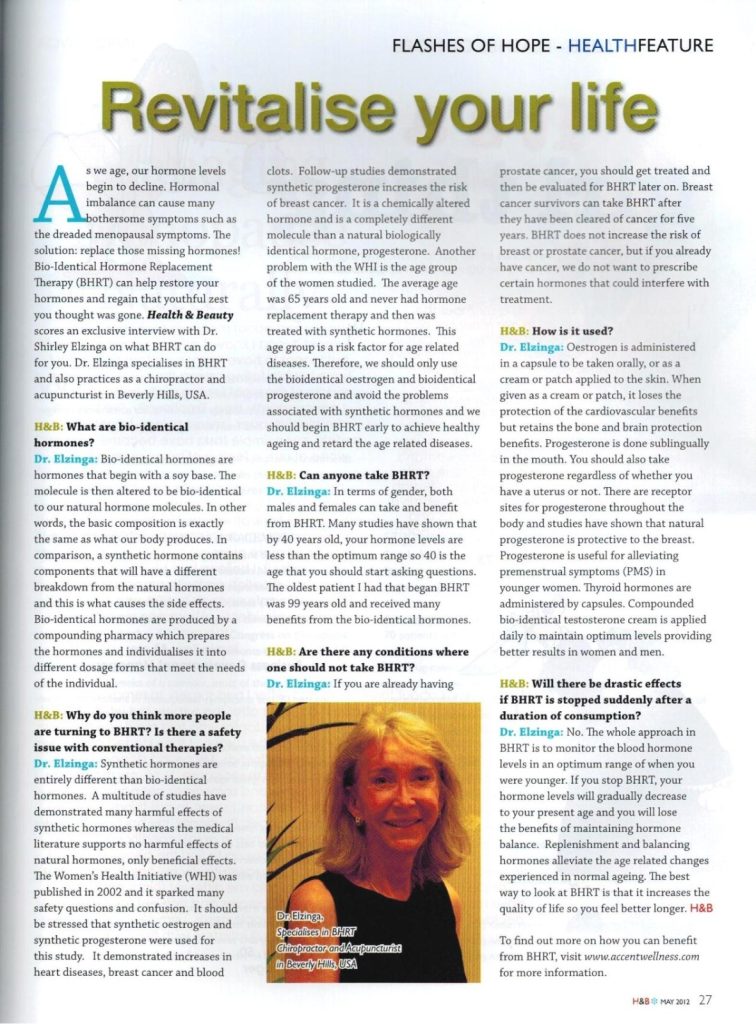
Dr. Elzinga, Specialises in BHRT Chiropractor and Acupuncturist in Beverly Hills, USA
Source: Accent Wellness
Welcome to WordPress. This is your first post. Edit or delete it, then start writing!


This Profile in Personalized Medicine highlights Stephanie Yang, owner and co-founder of Accent Wellness Compounding Pharmacy in Subang Jaya, Selangor,...

We are pleased to share that our global partner, Professional Compounding Centers of America (PCCA), was recently featured on BFM’s...

When Stephanie Yang started Accent Wellness, compounding pharmacies were an unfamiliar concept in the country. Today, with more and more...